
You’re invited to a
Facebook LIVE Q & A
with the KPBSD Instructional Team
Thursday, March 22, 2018
7:00 – 7:30 p.m.
How-to watch:
It’s simple. Go to the KPBSD Facebook page on 3/22/18, at 7:00 PM, via your device or computer, and connect! You’ll see that KPBSD is live – click to view.
How-to ask questions or share thoughts:
Post your questions ahead of time on the Facebook event page, or live during the event in a comment on the live video.
How Facebook LIVE Q&A works:
- KPBSD launches Facebook LIVE video, viewers click to view, and see content live in real time.
- Viewers type comments into the feed below the video.
- KPBSD does not “see” viewers via videoconferencing, this is a one way video view feed from KPBSD. Interaction happens via comments and post likes or emojis.
Everyone is invited to tune in – KPBSD parents and students, staff, community members, KPBSD partners, and KPBSD Key Communicators. Afterwards, the Q&A will be saved as a video to review at your convenience.
Why?
This Facebook live event is the first in a series to expand the KPBSD Key Communicator program, engaging our people and publics with conversation, and offering accurate stories, information, and responses to questions about the KPBSD. Please join in, and offer your thoughts and ideas.
Tip:
You don’t need a Facebook account to watch live.
- At 7:00 PM, go to https://www.facebook.com/livemap. Locate the live event streaming from Soldotna, Alaska, using the interactive map.
- Click the blue dot indicating Facebook LIVE is happening in Soldotna, and the video will pop up.
- Click on the video image to enlarge it on your screen. https://www.facebook.com/livemap
- note: You cannot post questions without a Facebook account. You can email them to communications@KPBSD.org, and we will answer as many as we can during the video LIVE Q&A.
The mission of the Kenai Peninsula Borough School District is to empower all learners to positively shape their futures.
www.KPBSD.org
Facebook Kenai Peninsula Borough School District
Questions?
Contact Pegge Erkeneff, KPBSD Communications Liaison, communications@KPBSD.org. Or private message Kenai Peninsula Borough School District on Facebook.

Posted in News Release by .
KPBSD and The Legislature
School Board Leadership and Youth Advocacy Institute
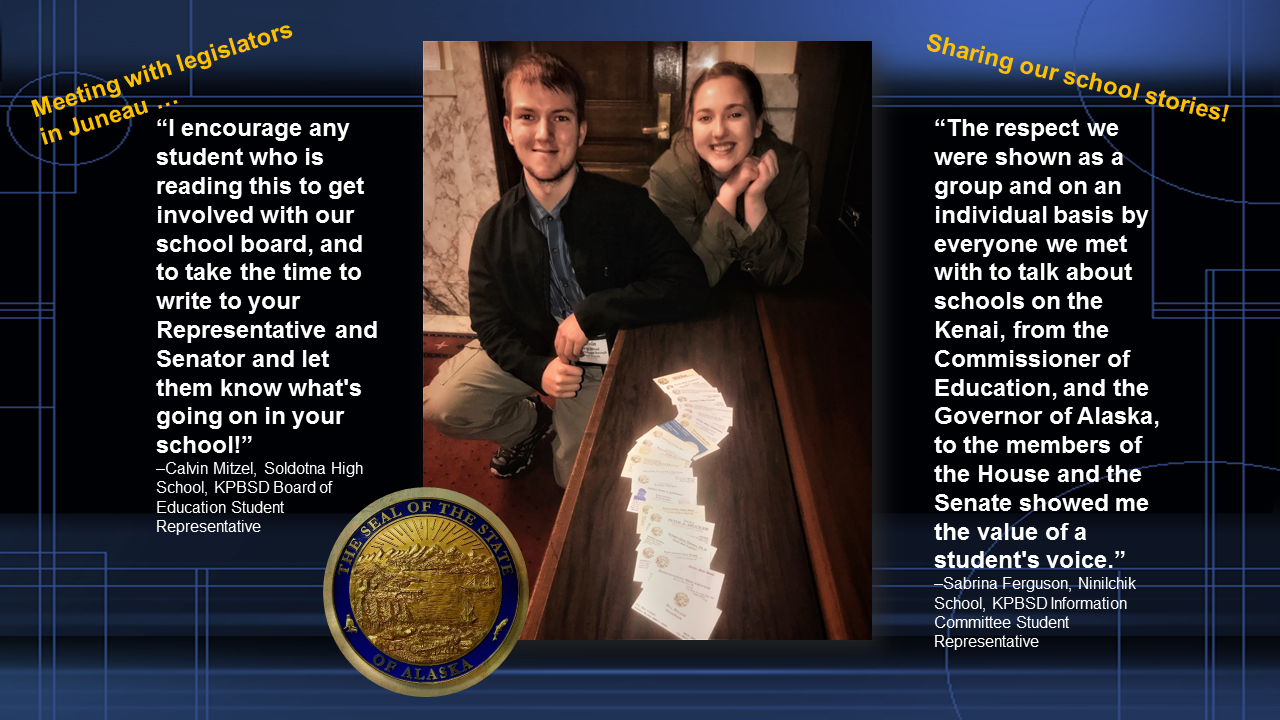
A full weekend of learning and collaborating with school board members and students from around the state, plus two days of appointments with more than 25 legislators to share “Kenai schools” stories was fun, informative, and thought provoking! February 10–13, 2018, two students, three school board members, a Soldotna Prep teacher, and the district communications liaison participated in the Alaska Association of School Board (AASB) Legislator Leadership Flyin and Youth Advocacy Institute in Juneau, Alaska.
Whether it was testifying at a hearing, being introduced on the House of Representative floor, meeting with Governor Walker around his many yards long conference table, or the many excellent questions and facts and figures shared, our team was so well received. Aides and legislators showed our young people and team kindness, genuine interest in schools, and affirmation about the diverse schools in KPBSD. Two KPBSD student leaders reflect on their experience:
Highlight of High School
“Going to Juneau was the highlight of my high-school experiences. Having the opportunity to go to the state capital building and seeing, first hand, how hard our government works for us opened my eyes to the challenges we, as a state, face. I was proud to be a part of a group with such a positive attitude and the ability to articulate the needs of not only our district but all the districts of our state. The respect we were shown as a group and on an individual basis by everyone we met, from the Commissioner of Education, the Governor of Alaska, to the members of the House and the Senate showed me the value of a student’s voice. I have personally been advocating for education for many years, I feel my voice was truly heard in Juneau. I had several legislators stop me in the halls of the capital building to tell me they appreciated my voice and the positive message the Kenai Peninsula Borough School District conveyed. Thank Goodness for the DREAM TEAM of three school board members, two students, a teacher, and our communications liaison!” – Sabrina Ferguson, Ninilchik School, KPBSD Information Committee Student Representative
My Experience
“I had the pleasure and honor of meeting with Representatives and Senators from across the state during the February legislative fly-in with the school board and youth advocacy institute. It was a great time, opened my eyes to so many different things, and an opportunity to promote our wonderful district. I realized that the representatives and senators love hearing from kids! They love hearing what we have to say, and what we think needs changed or improved. Our local school board is just such a wonderful group of people! I loved every moment and aspect of the time in Juneau, and I encourage any student who is reading this to get involved with our school board, and to take the time to write to your Representative and Senator and let them know what’s going on in your school!” – Calvin Mitzel, Soldotna High School, KPBSD Board of Education Student Representative
Alaska Association of School Boards website
KPBSD and The Legislature webpage

Governor Bill Walker meets with the Kenai Peninsula Borough School District in the Cabinet Room at the State Capitol in Juneau, Alaska, February 12, 2018.
David Lienemann/Office of the Governor
Posted in KPBSD District Stories by .

Kenai Peninsula Borough School District
Golden Apple Award | March 5, 2018
Mrs. Devin Michel Way, educator Port Graham School
Every school deserves to have at least one teacher as charitable and distinguished as Mrs. Devin Michel Way, for it is teachers like her that cause positive change not only in their own classrooms, but across the staff and beyond. Mrs. Way is a superlative example of an educator who cannot help but give of herself, and who moves through her practice with grace, no matter how large the task and no matter how much she offers to do. Her generosity of spirit builds relationships and trust, and on that foundation Mrs. Way acts as a guide for students and staff to learn and grow.
A tightly choreographed dance
A kindergarten through fourth grade teacher at Port Graham School for the last three years, and a veteran teacher of eleven years, Mrs. Way is a master at differentiating for each and every student across five grades. For many, teaching five grade levels would be daunting, if not impossible, but Mrs. Way succeeds extremely well. Her expertise has grown from her unique experiences, including teaching preschool in Pennsylvania, fifth grade in the Marshall Islands, and a span of preschool to elementary grades in the village of Point Lay. Watching Mrs. Way’s classroom is akin to watching a tightly choreographed dance. Students know the steps, established early on, and learn happily in a relaxed, student-centered environment. Mrs. Way makes this dance look easy, and in her nurturing manner, Mrs. Way provides support to all. While soothing a crying kindergartener, she might chat with her fourth graders about a theme in a novel. All the while, other students are launched on their independent or collaborative projects. Too, over the year, students’ projects branch out into the community to provide service. She is truly an amazing teacher.
Responsibility
Without being asked, Mrs. Way assumes a high level responsibility at Port Graham School beyond the classroom in communications, public relations, and day-to-day functions. Without a principal on campus four days per week, there are myriad challenges, including scheduling variances, community concerns, guest speakers, special events, student support, staff absences, mechanical issues (such as recently testing a generator!), internet outages, and nameless other issues. Mrs. Way cheerfully helps with these challenges. She communicates regularly with her principal, and follows protocols. She keeps parents informed of school activities, and acts as editor on the school Facebook page. She engages with all students, not just her own. She also coaches middle school cross country running, is the Assessment Coordinator, school librarian, and serves on Port Graham Site Based Council. She provides stability for the entire school. Mrs. Way does this all with a gentle spirit, willing attitude, and love for people.
Professional Development
A particularly extraordinary aspect of Mrs. Way’s practice that goes above and beyond is her remarkable ability and eagerness as a professional development facilitator for Port Graham and Nanwalek Schools. This role began as a stipend position, during which Mrs. Way exceeded expectations by fully facilitating in-services, early release days, and collaborations. When the stipend was no longer available, she stepped forward to continue, and leads collaborative sessions for all instructional staff in both locations that could be likened to seminars led by professional facilitators. With a sensitivity to the needs of our K-12 rural schools, agendas center on initiatives such as personalized learning and ConnectED, with practical applications to multi-graded settings. With poise and a touch of authority, Mrs. Way facilitates new concepts, engages meaningful discussions, and requires participants to collaborate on products that can be applied to current practice.
Apple and ConnectED
iPads for Orcas
Recognizing her skill and importance as a professional development facilitator, Apple, Inc. invited Mrs. Way to the Dallas ConnectED Academy with Team Nanwalek last February. Mrs. Way had helped initiate the “iPads for Orcas” technology program in Port Graham, earned status as an Apple Teacher, and is a constant resource to teachers in many areas, including technology. Apple Education Development Executive Katie VanSluys was excited to have Mrs. Way’s participation because of her collaborative nature and generous spirit. Ms. VanSluys stated, “Having worked with Devin over the course of two years—launching and growing programs to integrate and innovate with technology, it became immediately clear to me that Devin is a learning leader. Her work with kids and colleagues is passion-filled, professional, and caring. Her actions model what we, as educators, want to develop in our students. Devin identifies challenges, approaches problem-solving with intrigue and stamina, engages others gracefully and strategically, and finds joy in process of learning. She is a remarkable educator, respected colleague, and inspiring teacher to me and countless others.”
“Mrs. Devin Michel Way exemplifies what we dream that all educators can become,” said Principal Nancy Kleine. “We are fortunate that Mrs. Way is teaching in our district, and is driven to share her expertise with others. Mrs. Way is one of the finest educators because she reaches a hand out to share with others.”
The Kenai Peninsula Borough School District Board of Education is proud to recognize Mrs. Devin Way for her dedication to the students of the school district, past, present, and future.
Posted in Awards by .
KPBSD
School “Safety Closure” information

After extensive research and study of historical and recent school safety incidents, the U.S. Department of Education issued a new document with new guidelines for school safety entitled “Guide For Developing High-Quality School Emergency Operation Plans.” One of the major findings was that the lone option to lockdown was no longer enough. It was stressed that “as the situation develops, it is possible that students and staff will need to use more than one option.” In order to give our staff and students more options to protect themselves, KPBSD adopted the ALICE protocols to be used when the presence of a violent intruder necessitates a “Safety Closure.” ALICE is an acronym for:
ALERT
Use Plain and Specific Language. Avoid Code Words
Get the word out! Notify authorities and those in harm’s way of the danger at hand. The objective is a conveyance of plain, clear, concise and accurate information, not an issuance of a command. The goal is to empower as many individuals as possible with the ability to make an informed decision as to their best option to maximize their chances of survival!
LOCKDOWN
Barricade the Room. Silence Mobile Devices. Prepare to EVACUATE or COUNTER if Needed
Locking down and barricading entry points may still be the best option in some situations. The noise of cell phones and phone conversations could put students and staff in danger so all mobile devices should be silenced. ALICE training includes instruction on practical techniques to assist in better barricading the room. Pre-Planning and obtaining of materials can improve the ability to barricade. The time in Lockdown can be used to prepare for the use of different protocols (i.e. Counter or Evacuate) as the incident proceeds and situational information is supplied.
INFORM
Communicate the Intruder’s Location in Real Time
Inform is a continuation of Alert and uses any means available to pass on real-time information.
Communicate real-time updates throughout the incident to those involved. This can be accomplished through the use of video surveillance equipment, public address systems, or electronic updates. Updates during an incident allow those involved to make sound decisions about how to react and what steps, if any, to take next. Information should always be clear, direct and, as much as possible, should communicate the whereabouts of the intruder. Effective information can keep the intruder off balance, giving people in the school more time to further lockdown, or evacuate to safety.
COUNTER
Create Noise, Movement, Distance and Distraction
This protocol is used only as a “last-resort” or “worst-case” option if those involved have not been able to find a secured area, or their secure area has been breached. Staff and students are trained in disruptive actions that create noise, movement, and distance to distract, confuse, and gain control through age appropriate tactics. ALICE does not endorse civilians fighting an active shooter, but when confronted directly in a life-and-death situation, individuals should use any actions necessary to defend themselves.
EVACUATE
When Safe To Do So, Remove Yourself From Danger Zone
The goal is to safely put as much time and distance between the threat and our staff and students as possible. The decision to evacuate can be made at any time during the incident based upon information that becomes available. Evacuating to a safe area takes people out of harm’s way and hopefully prevents civilians from having to come into any contact with an intruder. Evacuation is the number one goal! When Evacuation is one of multiple protocols that are safely available, Evacuation should be the first choice.
It is important to understand that these protocols are age appropriate, not sequential or chronological, and those involved have the ability to change protocols as an incident progresses.
KPBSD’s change to the use of A.L.I.C.E. protocols has been done in conjunction with our local law enforcement agencies. These agencies also participate in the training of staff and students.
Posted in KPBSD District Stories by .
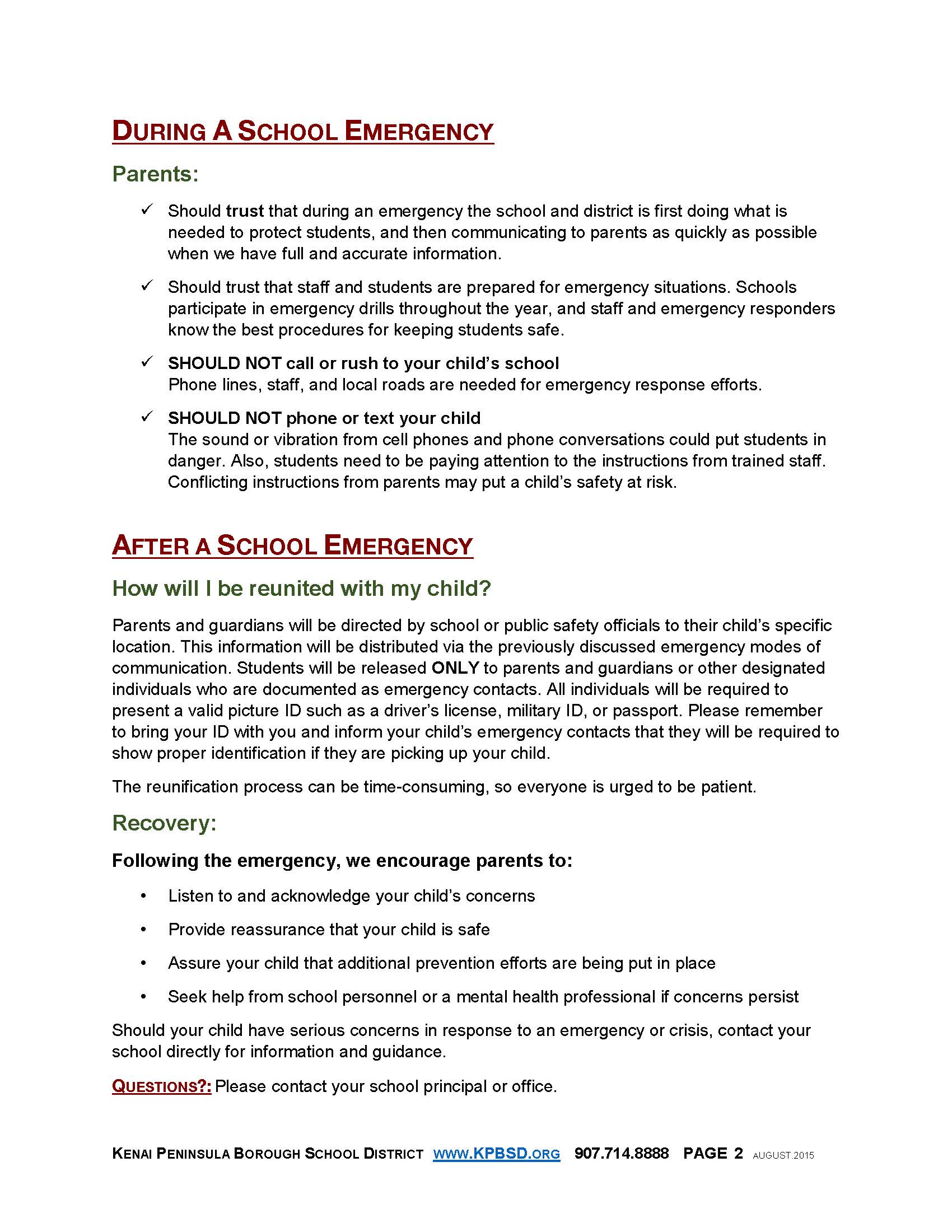
Parents and guardians, school safety is a top priority in the KPBSD. It’s important for you to know what to do before, during, and after a school emergency, weather related delay start, or school closure. Kindly read KPBSD Emergency Guidelines for Parents and Guardians. KPBSD regularly practices safety drills in schools, and includes law enforcement in our ALICE trainings for school emergencies. School delays and closures protocol.
Before A School Emergency

PARENTS NEED TO BE PREPARED
Contact information entered in PowerSchool is used to make emergency contact with parents. So that KPBSD can keep you informed, make sure your child’s emergency contact information is accurate, current, and updated as needed. That information may be used during an emergency to generate automated phone messages, emails, or text messages to parents from schools or the district office. Parents need to go to the school office to update and sign their information.
- Download the KPBSD Mobile App so you can automatically receive emergency update push notifications
- Become familiar with the KPBSD Facebook and Twitter social media sites where emergency information is posted
PARENTS NEED TO BE INFORMED
Familiarize yourself with these KPBSD emergency terms and procedures:
- Stay Put: A “stay put” takes place when a potential threat is identified in the school’s neighborhood. All school doors are locked but classes continue inside as normal. No entry into or exit from the school is allowed. Students will not be released until the situation is resolved and the “stay put” has been rescinded.
- Safety Closure: A “safety closure” takes place when a violent intruder is identified on school grounds or in the school building. The ALICE protocols will be followed. No entry into or exit from the school is allowed. Students will not be released until the situation is resolved and the “safety closure” has been rescinded.
- Shelter-In-Place: A “shelter-in-place” takes place when students take refuge in designated areas to be protected from hazardous materials or severe weather. Entry or exit from the schools will be controlled.
- Evacuation: In the event of certain building emergencies, students will be relocated to an appropriate evacuation assembly area. Students will be released to parents per district student release procedures.
During A School Emergency
PARENTS AND GUARDIANS
- Should trust that during an emergency the school and district is first doing what is needed to protect students, and then communicating to parents as quickly as possible when we have full and accurate information.
- Should trust that staff and students are prepared for emergency situations. Schools participate in emergency drills throughout the year, and staff and emergency responders know the best procedures for keeping students safe.
- SHOULD NOT call or rush to your child’s school
- Phone lines, staff, and local roads are needed for emergency response efforts.
- SHOULD NOT phone or text your child
- The sound or vibration from cell phones and phone conversations could put students in danger. Also, students need to be paying attention to the instructions from trained staff. Conflicting instructions from parents may put a child’s safety at risk.
After a School Emergency
HOW WILL I BE REUNITED WITH MY CHILD?
Parents and guardians will be directed by school or public safety officials to their child’s specific location. This information will be distributed via the previously discussed emergency modes of communication. Students will be released ONLY to parents and guardians or other designated individuals who are documented as emergency contacts. All individuals will be required to present a valid picture ID such as a driver’s license, military ID, or passport. Please remember to bring your ID with you and inform your child’s emergency contacts that they will be required to show proper identification if they are picking up your child.
The reunification process can be time-consuming, so everyone is urged to be patient.
RECOVERY
Following an emergency, we encourage parents to:
- Listen to and acknowledge your child’s concerns
- Provide reassurance that your child is safe
- Assure your child that additional prevention efforts are being put in place
- Seek help from school personnel or a mental health professional if concerns persist
Should your child have serious concerns in response to an emergency or crisis, contact your school directly for information and guidance.
Questions?: Please contact your school principal or office.
- KPBSD Emergency Guidelines for Parents and Guardians Flyer
- KPBSD School Safety and Closure Information
Link: KPBSD dedicated webpage: School Delays or Closures

Posted in KPBSD District Stories by .
News Release

Soldotna, January 29, 2018—Do you understand how the KPBSD school district budget will affect what KPBSD can offer in schools to educate our youth? If you wonder about what you can do, or what might change in the 2018-2019 school year, you’re invited to join a KPBSD February Facebook Live Q & A, and a budget forum in your community.
Learn: planning for 2018-2019 school year, KPBSD faces a $3.3 million dollar budget deficit.
Get Facts: You’re invited to participate online, or in person, to ask questions about revenue, expenses, funding, and cuts that potentially impact the classroom. Please become involved so as a community we can make informed decisions that will affect our schools. Parents, staff, students, business partners, community members, and elected officials—please participate:
Facebook Live Q & A
- Thursday, February 1, 7:00 – 7:30 PM, facebook.com/kpbsd
Community Budget Forums
- Homer High School Library: Tuesday, February 20, 5:30 PM
- Kenai Central High School Library: Thursday, February 22, 5:30 PM
- Seward High School Library: Tuesday, February 13, 5:30 PM
- Soldotna High School Library: Wednesday, February 21, 5:30 PM
- Susan B. English and Tebughna School: Wednesday, February 21, 5:30 PM Videoconference from Soldotna High School forum
“Our annual budget is one of the most important things we do each year,” said Dave Jones, assistant superintendent of instructional support. “We want to give our parents, staff, students, and community members a chance to learn about our budget, participate in the process, and ask questions.”
Be informed so you can advocate for the 2018-2019 school district budget which will define opportunities and offerings in August, 2018. The budget recommendation will be presented to the school board on March 5, 2018.
“Alaska is addressing its ongoing fiscal challenges, and it is important that everyone is involved in the conversation to ensure a long-term fiscal plan is implemented,” said Sean Dusek, superintendent. “As a part of this conversation, we will continue to prioritize services to provide the most effective and efficient education possible for all of our students. Your voice will help shape those priorities as well as clearly communicate that all students should remain the number one priority in Alaska and the Kenai Peninsula Borough.”
Action ideas
- Attend a Facebook Live Q & A; community budget forum; KPBSD school site council meeting, school board meeting; Borough Assembly meeting; Alaska legislative opportunities with elected officials
- Communicate with your school, friends, neighbors, legislators, and elected officials
- View any of the other short videos that explain aspects of funding and budgets, and review handouts. Links:
- FY19 Preliminary Budget Information
- PDFand Video: FY19 KPB Revenue
- PDFand Video: FY19 General Fund Revenue
- PDFand Video: FY19 Fund Balance
- PDFand Video: FY19 Foundation Formula
- FY19 Budget FAQs, 10-17-17(pdf)
Webpage: KPBSD Finance Department
If the future success for our KPBSD K-12 students is dependent on a quality education so graduates will be prepared for college or a career, funding public education is crucial. KPBSD asks everyone to attend a public budget meeting, and become involved in the financial solutions for our school district and state.
###
 ►ALERT: TWO HOUR DELAY START on Tuesday, January 23, 2018, for KPBSD schools in the southern peninsula and Seward area, following an earthquake in Kodiak, and Tsunami warning. These schools will start two hours later than normal, and buses will run two hours later than normal.
*note: as of 4:15 a.m. the Tsunami alert for the coastal waters of Alaska is cancelled. However, these schools will be on a two-hour delayed start:
HOMER AREA:
Chapman Elementary School
Fireweed Academy
Homer Flex School
Homer High School
Homer Middle School
Kachemak Selo School
McNeil Canyon Elementary School
Nikolaevsk School
Paul Banks Elementary School
Razdolna School
Voznesenka School
West Homer Elementary School
ACROSS THE WATER IN SOUTHERN PENINSULA:
Nanwalek School
Port Graham School
Susan B. English School
SEWARD AREA:
Moose Pass Elementary School
Seward Elementary School
Seward High School
Seward Middle School
Be safe everyone, and get some sleep!
For updates on emergency alerts in the Kenai Peninsula Borough, follow the Kenai Peninsula Borough on Facebook and register for rapid-notify through the Borough.
Two KPBSD Distance Learning Students have been invited to represent Alaska in the National Microsoft Championships!
Most of us on the Kenai Peninsula will never make it to the Olympics. But for our KPBSD students that are enrolled in a Distance Computer Applications course, there’s another kind of world championship up for grabs.
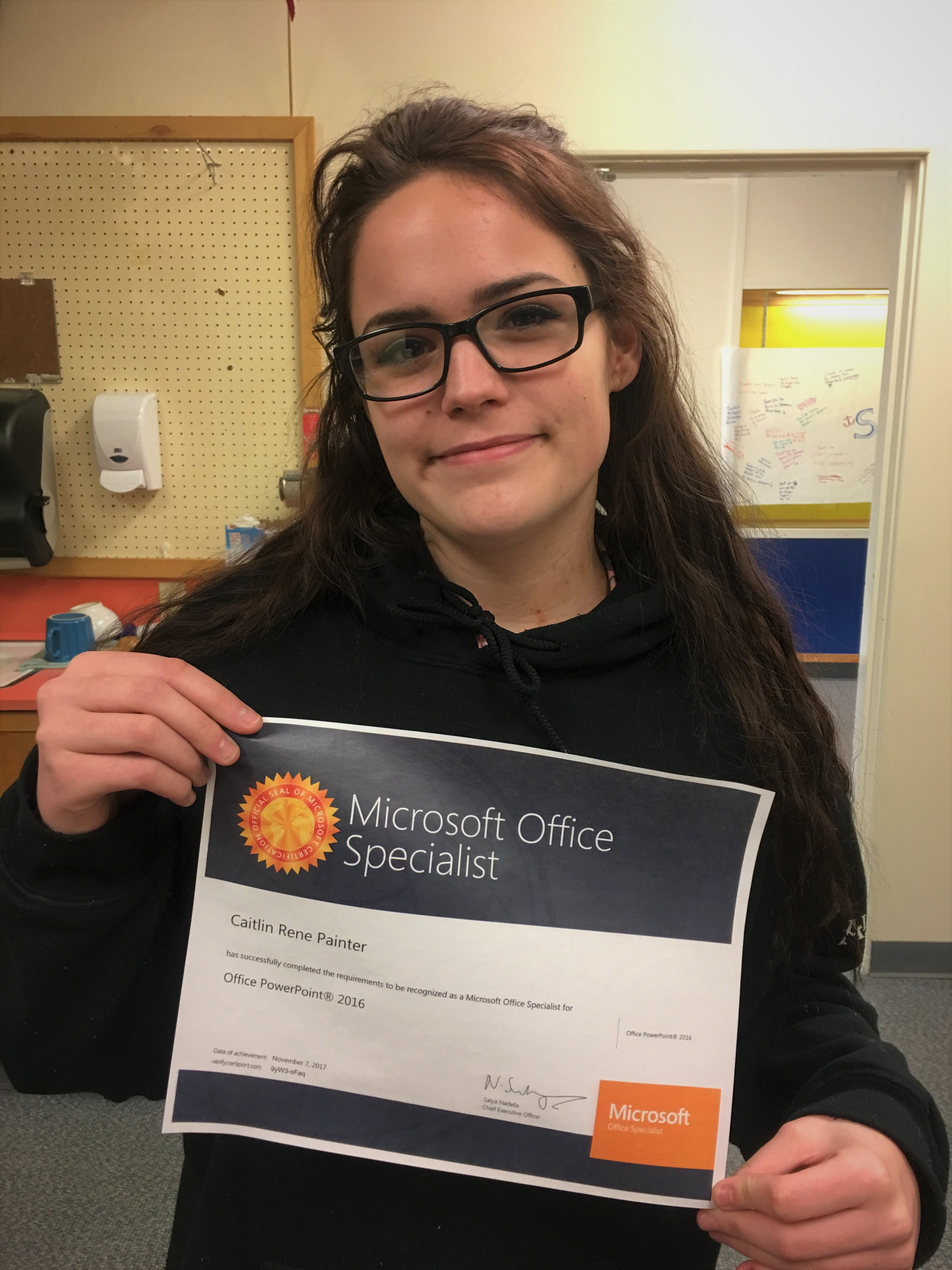
Caitlin Painter, 11th grader at Ninilchik School, and Ethan Bott, 12th grader at Soldotna High School, who because of their exceptionally high scores in their Microsoft Office Specialist (MOS) Certification exams, have both been named Alaska’s Champion and selected to compete in Certiport’s 2018 Microsoft Office Specialist U.S. National Championship at the Marriott Marquis in Atlanta, Georgia, June 13-15, 2018.
“The number of students entering this competition in the United States continues to grow rapidly – we had more than 320,000 total entrants last year, and many U.S. Champions have gone on to compete- and place- at the MOS World Championship where they matched up against students from all over the world,” said Aaron Osmond, General Manager, Certiport. “More importantly, the level of expertise is astounding – we are so pleased to see this competition not only promote industry-endorsed certification but also prepare students for long-term college and professional success.”
During the 2018 MOS U.S. National Championship event, student competitors will take a unique exam in their track, further testing their knowledge of the applications. One winner per track will be named the 2018 MOS U.S. National Champion, and each will win an all-expenses-paid trip to compete in the 2018 MOS World Championship in Orlando, Florida, July 29 – Aug. 1, 2018.
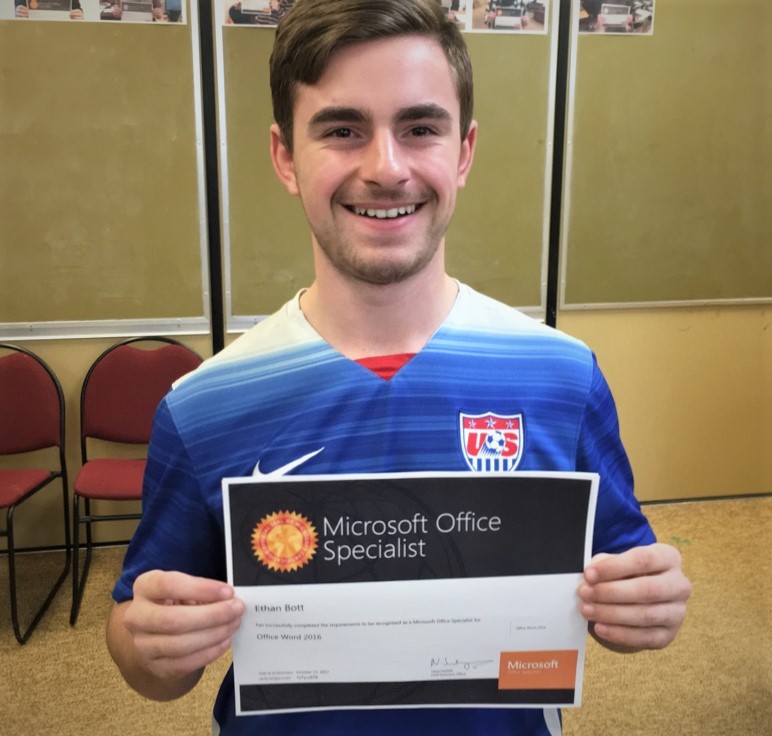
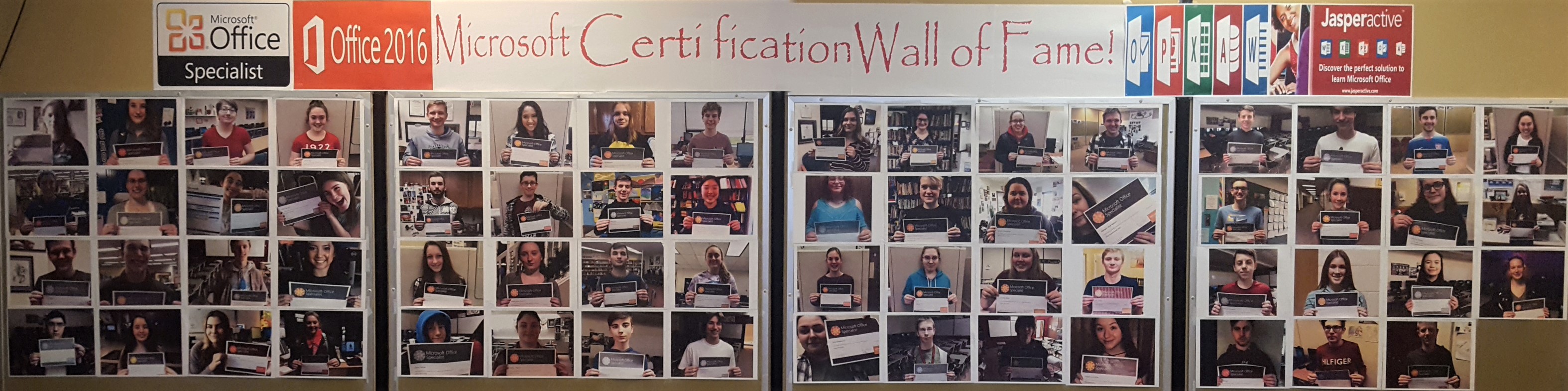
Darren Jones, KPBSD Distance Computer Teacher said, “We are fortunate to be able to offer every high school student and teacher in the district the opportunity to take our online Computer Applications courses that provide them opportunities to earn several Microsoft Certifications. So far from the 1st semester of the 2017-2018 school year, 67 KPBSD students and one teacher (Kristin McGlothen a SoPrep Science Teacher) received at least one Microsoft Certification.”
Certifications awarded
Certifications were from the following schools across the district: 29-Soldotna High School; 15-Kenai Central High School; 11-Soldotna Prep School; 7-Connections HomeSchool; 3-Nikiski Middle-High School; 2-Nikolaevsk School; and 1-Ninilchik School. Of the 68 certifications earned, 44-Certified in Microsoft Word; 15-Certified in Microsoft PowerPoint; 5-Certified in Microsoft Excel; and 4-Certified in Microsoft Outlook.
Through the KPBSD’s articulated agreement with the Kenai Peninsula College, students can earn up to 12 college credits by taking and successfully completing our online Computer Applications 1-4 courses and earning Microsoft Certifications.
Link: KPBSD Distance Education webpage
Posted in Awards by .
 “What does Personalized Learning (PL) look like in the classroom?” is quizzed back and forth in education circles, and students and parents even wonder and ask questions!
Every teacher, group of students, and scenario is unique, and personalized learning is adaptive. To offer a look into the practices of PL, meet Mrs. Amy Angleton, a KPBSD English and Language Arts teacher at Skyview Middle School in Soldotna, Alaska.
Every day of the week offers something unique for the students, and Amy takes the weekly schedule for her classes and creates a consistent rotation schedule for the students. On Tuesday, Wednesday, and Thursday, they move through stations in their classroom that include independent work with technology integration for delivering some content, collaboration with other students, and application of the writing process with one-to-one conferencing with her.
To dive further into what happens with the one-to-one conferencing, Amanda Adams, KPBSD personalized learning specialist, asked Amy about what happens when she has the opportunity to meet with each student individually to guide, support, teach, and reflect with them about their needs, and successes one to three times individually, in addition to general class time interaction. This type of student reflection and goal setting is directly connected to the Core Four of Personalized Learning in KPBSD.
“The benefits for Mrs. Angleton and her students is crystal clear,” said Adams. “She knows her students on a personal level that has never been achieved before this point in her career. This is all about them and their individual needs! Grading becomes teaching and offers so much more opportunity for investment from the students. It is important to note that the logistics of shifts like this take dedication to really figure out a system, but no one says it better than Amy herself, ‘I can honestly say that I have never felt more effective as a teacher than I do with one-on-one conferencing.’”
One-on-one conferencing with students
Conversation with Mrs. Amy Angleton, Skyview Middle School teacher
“Language Arts is one of those weird subjects that isn’t linear. Once students learn to read and write at a foundational level, they step off of a line and jump into this pool of language arts skills that they grasp onto or not. This creates a problem for Language Arts teachers that may have students who are strong at grammar skills but cannot think deeply in the same room with students who have great ideas but cannot form a coherent thought on paper. With such diversity in student writing abilities, one-on-one teaching is really the only way to teach students what they need to improve their writing. One-on-one conferences is when the teacher schedules meetings with each student throughout the week to read their work with them and discuss the student’s strengths and weaknesses in the skill being demonstrated.”
How do you do it?
Let’s be honest. Creating one-on-one conferencing time with students each week is not easy, but the benefits definitely make the pre-work worth every minute of time.
I create time with students by having three stations. The students rotate to the stations on Tuesday, Wednesday, and Thursday each week. One station is on the computer. This is where students watch lecture videos, take notes, do research, and other independent work. The second station is a collaborative station where students work on a skill with a partner that revolves around a classroom reading. This station usually requires a little direction from me but then continues independently of the teacher the rest of the period. The last station is the writing station. Here students work through the writing process. They write, they edit with peers, their revise, they edit again. I conference with students at this station. Sometimes I let them come to me when they are ready, and other times I invade their space and sit with them (some students I have to go to as they would never willingly seek me out—but they are getting better). When I conference with them I use a checklist that includes all different skills needed in their writing. I think out loud and tell them what skills they have and what skills they need to work towards mastering. If they are not satisfied with how well they did, they continue working on their writing, and then have another conference with me before the end of the day to see how they have improved. On Friday’s and Monday’s if they wish another on-one-on conference with me they can seek me out on those days.
At the beginning of each quarter I have students write a pre-assessment paragraph in the structure that will be the focus for that quarter. The following week during my conference with each of them I score that paragraph with them. Then they record their score on the board. Each time I grade their writing they get a new score they can record on the board.
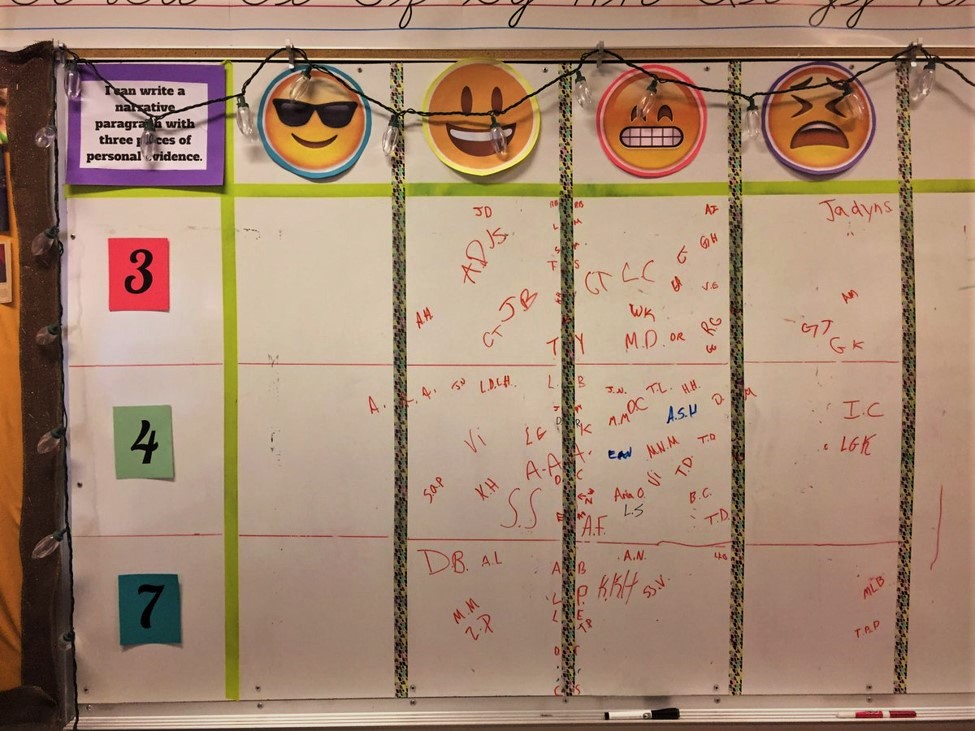
*Student data tracker. The skill in the top left corner and the emojis represents 1-4 on the rubric.
Why is one-on-one conferencing beneficial?
“One-on-one conferencing is beneficial for teachers. Of course it is beneficial for students, but let’s be selfish for a minute. Teachers work endlessly until they eventually say good enough at the moment and go home to try to relax with their families and get some rest. But when they are home, most teachers are still stressing about school and students and what they could have done better. One-on-one conferencing has made my life (not just my teaching life) easier. Each quarter I focus on one particular writing structure with students. That structure is the big skill that I assess. Instead of students doing a test they turn into the basket, then me taking those tests home to grade (and while grading thinking about talking to a student that isn’t there about what they should or could have done differently or better—I don’t think I’m the only teacher who talks to herself when she grades—I now grade these assessments with the student sitting next to me during class time. Suddenly, I have taken the stress of finding time to grade assignments out of my teaching practice, and I have turned grading into teaching. Students receive instant feedback on their individual skills, turn around and improve. I am no longer trying to teach every little skill that is needed in order to write an effective paragraph or essay. Now I am teaching writing holistically. I do not plan my quarters around what skills are needed to build up to an essay anymore (often missing some and mastering none). Instead, I plan writing prompts, and when I sit down with students to read their paragraph, I tutor them on the skills they need to improve their writing. Now I do not go home to grade papers, and I do not go home worrying about what I could have done differently.
I know at the end of every week that I met every student where they are in their ability and taught them something new. I can honestly say that I have never felt more effective as a teacher than I do with one-on-one conferencing.
What differences have you seen?
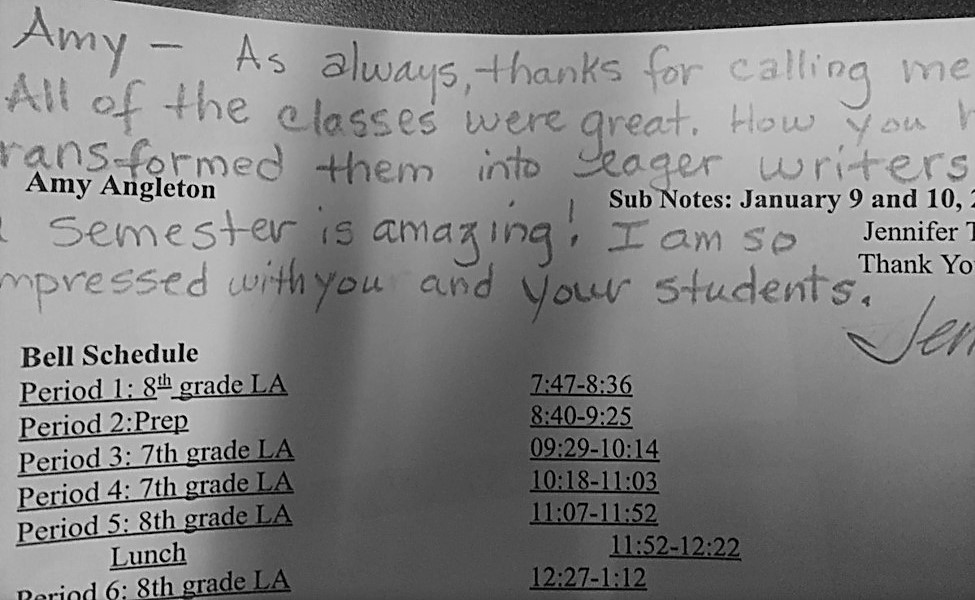
“I received this note from a substitute that has subbed for my classes throughout the year. On the day she wrote this note the students were writing their pre-assessment paragraph for the third quarter. As she described, my students are now “eager writers.” Eager writers! I never thought a junior higher would be described that way before now. Yes, there is the occasional student that enjoys writing but usually teachers can count those students on one hand now the opposite is true for my students. I can count on one hand the number of writers that resist writing. As I explained, students record their progress on the board throughout the quarter. I have students excited to move their initials up the board. I even have some students in competition with each other to see who can get their initials under the cool face (the one with glasses) the fastest.
Not only are students suddenly excited about writing and excited about showing me their improvements, I also know my students better than I ever have before. The first quarter they wrote about things important to them, and as I read these paragraphs, I talked to them about these things. I talked to students about the loved ones that they have lost, and about the sports they are passionate about, and which book series is better: Harry Potter or Percy Jackson (it’s Harry Potter hands down by the way). In years past I have tried to love every student and failed miserably. This year, I can honestly say, I love every one of my students. As a result, I feel more trust from my students, and they are more willing to do what I ask of them. And, they challenge themselves because they trust me!
Thank you to Amy Angleton and Amanda Adams for this story.
Links
- Video: Skyview Middle School #PL
- Webpage: Personalized Learning in KPBSD
- Blog: Personalized Learning in KPBSD
Connect on social media with personalized learning – look for #PLinKPBSD #PL #AKlearns
Do YOU have a KPBSD story to share about a teacher, student, class, staff member, or school? Please make time and do it!
Suggest or contribute a story online link: http://bit.ly/SuggestKPBSDstory
KPBSD will inspire all learners to pursue their dreams in a rigorous, relevant and responsive environment.
Posted in Personalized Learning by .
News Release
Developmental Screenings for newborns to age five in Seward and Soldotna areas
Empowering all learners, starting with newborns!
Soldotna, January 12, 2018—Free opportunity for a screening to learn a child’s early development, motor skills, speech, early learning concepts, vision, and hearing for children ranging from newborn to age five (not yet in kindergarten) are offered this month. Children will be seen by appointment only, and appointments are free.

Opportunity! Child Find Developmental Screenings
Seward and Moose Pass
Friday, January 19, 2018
Seward Community Library
239 6th Ave. Seward, Alaska
10:00 a.m. – 2:30 p.m.
*By appointment only – call PJ at 907-422-1053 to schedule an appointment or for more information. SeaView Community Services Infant Learning Program and the KPBSD Child Find Program
Central Peninsula
Friday, January 26, 2018
Red Diamond Center, Suite 32 B, Soldotna, Alaska
9:00 a.m. – 3:00 p.m.
*By appointment only – call 907-714-6647 to schedule an appointment or for more information.
Frontier Community Services Infant Learning Program and the KPBSD Child Find Program
Southern Peninsula area
Date not yet determined – it will be in February 2018
###
Posted in Community Partners KPBSD District Stories by .